The Stephan Angeloff Institute of Microbiology
Member Of The International Institut Pasteur Network


The Stephan Angeloff Institute of Microbiology
Member Of The International Institut Pasteur Network
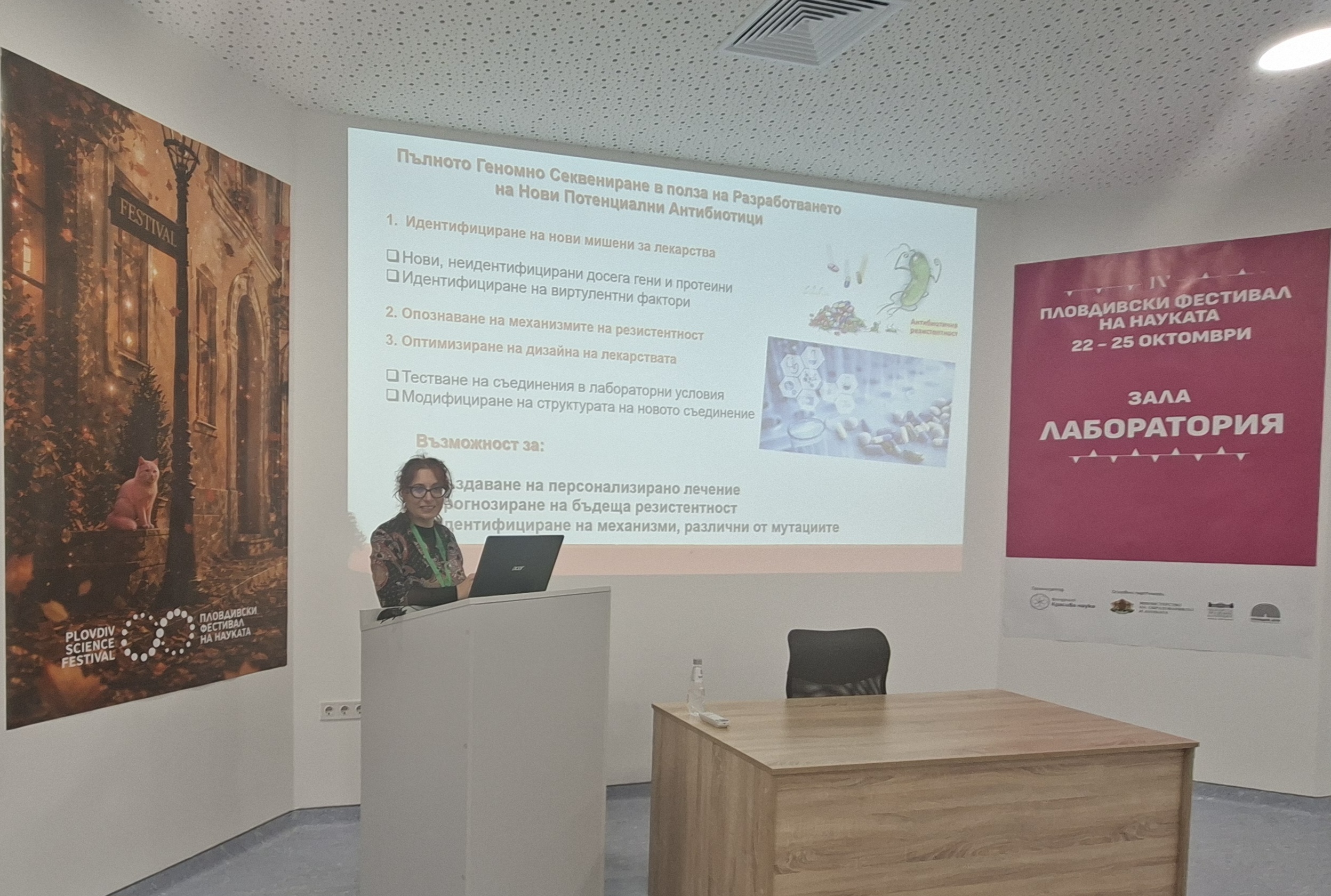
Scientists from the Stephan Angelov Institute of Microbiology at the Bulgarian Academy of Sciences gave lectures at the fourth edition of the Plovdiv Science Festival. Assoc. Prof. Petya Dimitrova, PhD, and Assoc. Prof. Violeta Ruseva, PhD, presented, in an accessible way, topics related to inflammation and the immune system, as well as tuberculosis and the growing problem of antibiotic resistance. In the “Young Explorer” Zone, Chief Assist. Prof. Snezhana Rusinova, PhD, introduced curious visitors to the Antarctic microworld.
In the lecture “Recovery from Inflammation in Diabetes, Cardiovascular Diseases, and Arthritis,” Assoc. Prof. Petya Dimitrova, PhD, presented new perspectives on the nature of inflammation. According to current research, most diseases associated with chronic inflammation, such as diabetes and cardiovascular diseases, result from failures in its resolution. The speaker outlined current approaches to managing chronic inflammation by activating the body’s natural resolution mechanisms.
Assoc. Prof. Dimitrova also introduced the audience to the work of the European scientific network EU-RESOLVE, which brings together researchers from various disciplines to study the mechanisms behind the active resolution of inflammation and tissue repair.
One of the oldest and deadliest infections in human history was the focus of the lecture “Tuberculosis in the Era of Resistance: New Challenges and Innovative Solutions.” Assoc. Prof. Violeta Ruseva, PhD, spoke about the spread of tuberculosis worldwide and in Bulgaria, the groups most vulnerable to the disease, and the reasons why its treatment is sometimes particularly difficult. The disease, also known in Bulgarian as “dry disease” or “white plague,” has been known since antiquity: evidence of it has been found in Egyptian mummies more than 3,000 years old, and ancient texts describe it as “phthisis,” a disease of wasting away. Although it was considered a “disease of the poor,” it also afflicted the aristocracy; its victims include the writer John Keats, the composer Frédéric Chopin, and Emperor Napoleon III. Bulgaria has also been affected by the disease, but after the Second World War, with the introduction of compulsory BCG vaccination and mass preventive screening, the country made significant progress in curbing it. By the end of the 1970s, it was among the countries with the lowest incidence rates in Europe. After the 1990s, however, economic hardship and shrinking healthcare resources led to a renewed rise in cases, especially among vulnerable population groups.
Under the guidance of Chief Assist. Prof. Snezhana Rusinova, PhD, the interactive stand in the “Young Explorer” Zone turned children and young people into polar explorers. They examined authentic materials, learned how to survive in extreme conditions, and became closely acquainted with the biodiversity of the icy regions.






Acad. Georgi Bonchev street
blok. 26, Sofia, zip 1113
tel.: +359 2 979 31 57
+359 879 499 167
e-mail: micb@microbio.bas.bg
Cellular Biosystems Laboratory
Plovdiv, zip 4000
139, Ruski blvd.
Manager: Assoc. Prof. Vasil Georgiev, PhD
Metabolomics Laboratory
Plovdiv, zip 4000
139, Ruski blvd.
Manager: Prof. Milen Georgiev, PhD
Laboratory “Ecology of pathogenic bacteria”
Veliko Tarnovo, zip 5002
78 Nikola Gabrovski Str., floor. 4
Manager: Assist. Prof. Zvezdimira Tsvetanova, PhD